


As the global landscape of pharmaceutical innovation undergoes a restructuring, China’s clinical trials have transitioned from “playing catch-up” to “keeping pace,” establishing significant advantages in terms of subject resources, enrollment efficiency, competitive dynamics, and commercialization. The country is gradually emerging as a core hub for global new drug R&D. Particularly in the field of oncology, these advantages are fully demonstrated in Phase II and III clinical trials of innovative drugs, such as antibody-drug conjugates (ADCs), providing an efficient pathway for global new drug development.
China's Key Advantage
China has a significant advantage over Western countries in terms of the size of its study population. China ranks first globally in both new cancer cases and cancer deaths, according to the International Agency for Research on Cancer (IARC) Global Cancer Statistics Report 2022[i][1] (published in “The Journal of Clinical Oncology” in April 2024).
There were a reported 19.976 million new cancer cases worldwide in 2022, with China accounting for 4.825 million of these new cases; this represents over 24% of the global total, ranking first worldwide. This provides an abundant pool of potential participants spanning diverse age groups and physical conditions, enabling a more comprehensive assessment of a drug’s efficacy and safety across a broad population. Compared to the challenges of participant recruitment and homogeneous population structures in Western countries, China can rapidly assemble a cohort of participants who meet trial criteria.
Taking a single indication as an example, there is a substantial volume of data from clinical trials for non-small cell lung cancer worldwide. Among the 379 Phase III clinical trials in China (mainland), the average enrollment rate was 1.12 patients/research site/month[i]. This far exceeds the rates in developed Western countries such as the United States, Germany, and Poland.
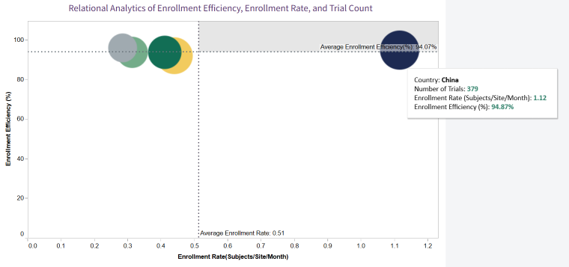
China’s healthcare system is highly centralized, with a high concentration of 'Grade A' tertiary hospitals and specialized cancer hospitals. Additionally, local sponsors collaborate closely with research sites, are more familiar with ethical review processes and patient demographics, and can respond quickly to issues arising during patient recruitment. At the same time, the “tacit approval” system significantly reduces the time required to initiate clinical trials, further improving enrollment efficiency.
China's Competitive Edge
China’s competitive edge in the clinical trial landscape is particularly pronounced. Competition in the clinical trial sector is fierce in Europe and the United States, where high-quality medical resources and trial participants are fiercely contested by numerous multinational pharmaceutical companies, and trial costs can be high. In contrast, the direct cost per patient for Phase III clinical trials in China is only one-third[i] of that in the United States.
Meanwhile, China’s innovative drug R&D ecosystem continues to improve; as domestic pharmaceutical companies rise, the competitive environment has become more inclusive, and the mature local CRO/SMO system provides efficient support for trials. In the ADC sector, China accounted for 34% of newly initiated global ADC clinical trials in 2025, surpassing the United States’ 31%[ii]. Taking Hengrui Pharma’s HER2 ADC product SHR-A1811 as an example, during its Phase I/II trial for non-small cell lung cancer, there was no cutthroat competition from similar trials, allowing the company to concentrate its resources on advancing the project. Benefiting from this favorable competitive landscape in clinical trials, the product successfully generated key Phase II clinical data and secured priority review and approval (conditional approval) based on these results, accelerating its market launch.
In contrast, during the same period in Europe and the United States, multiple similar ADC products were conducting Phase I/II–III trials, leading to severe subject diversion and repeated delays in trial progress.
The World's Second Largest Pharmaceutical Market
China holds a significant advantage over Europe and the United States in terms of commercializing products. China boasts the world’s second-largest pharmaceutical market, and regulatory authorities have introduced a “30-day fast-track approval process,” which has significantly shortened the timeline for innovative drugs to move from clinical trials to market launch.
At the same time, China’s health insurance coverage mechanism is continuously improving, enabling the rapid inclusion of innovative drugs in health insurance coverage and accelerating market penetration. Taking Hengrui Pharma’s HER2 ADC product SHR-A1811 as an example, after completing Phase III clinical trials for advanced or metastatic HER2-positive breast cancer, it was designated as a breakthrough therapy and granted priority review and approval. It received marketing approval from the China National Medical Products Administration (NMPA) in just six months and was included in the 2026 edition of the CSCO Breast Cancer Diagnosis and Treatment Guidelines as a newly recommended treatment regimen for HER2-positive advanced breast cancer.
This occurred at a swift pace, where it was added to the guidelines immediately upon approval. It was also rapidly included in the national medical insurance directory; in contrast, similar ADC products in Europe and the United States face approval cycles of 12–18 months after completing Phase III trials, and it often takes 3–5 years for them to be included in local medical insurance programs, resulting in a market commercialization efficiency that can be significantly lower than in China.
Conclusion
In summary, the strengths of China’s clinical trials (including the size of its subject pool, rapid enrollment rates, competitive landscape, and commercialization capabilities) provide a robust foundation for the development of innovative drugs. As exemplified by ADC products in the oncology field, China has firmly established itself as a key hub for global clinical trials and will continue to leverage its strengths to drive high-quality global pharmaceutical innovation.
References:
U.S. Food and Drug Administration (FDA)
-
[i] © GlobalData Plc 2026
-
[ii] © GlobalData Plc 2026
-
[iii] China Clinical Trials: Cost, Speed & Regulatory Advantages for Global Pharma
-
[iv] 2025 American Society of Clinical Oncology (ASCO) ADC Research Report
Author:
Gerald Li- Regulatory Affairs Director
Kelvin Yu, Business Development Manager